BD | NY 2020 Virtual Conference - "The Seelbach Story"

Campo Architects’ own Kerry Soniat participated in the Boutique Design New York 2020 Virtual Conference that took place earlier this week. With over 40 influencers packed into two days of virtual presentations, the conference offered much needed inspiration to offset the change of venue from NYC due to COVID-19. This year’s conference kicked off with four panels featuring leaders among the hospitality development and design industry. The panels provided insight on struggles faced as a result of the pandemic and shared strategic solutions for moving forward as an industry. All panelists emphasized the importance of partnerships now more than ever, and how to establish effective collaborations to develop a successful project. Day two of the BDNY conference held five panels focusing on women leadership in hospitality, the NEWH Beyond design competition, boutique hotel design, hospitality hybrids typologies, and the story of the Seelbach hotel.

“The Seelbach Hotel Story” panel was moderated by Michael Suomi (President, Suomi Design Works). In addition to Kerry Soniat (Campo Architects, Project Architect), the panel also featured Bethany Gale (Interiors Associate, Stonehill Taylor), Jim Merkel (President and CEO, Rockbridge Capital), and Chris Rupp (Sr. Vice President, RB Hotel Development). With the Owner and design team, this panel focused on the rich history of this luxurious hotel and how the renovation plans to bring its iconic architecture back to life.

BDNY-2020-VIRTUAL-CONFERENCE-THE-SEELBACH-STORY.jpg
The Seelbach Hotel - Historic postcard.jpg

Founded by brothers Louis and Otto Seelbach, the Seelbach Hotel opened in 1905 on the outskirts of then downtown Louisville, Kentucky. Since its inauguration, the Seelbach Hotel has had enormous success, which led to subsequent additions to the building in its early years of operation. The hotel’s European-inspired grandeur resulted in the shift of Louisville’s downtown hub and reshaped the city’s planning efforts. Over the past 115 years, the Seelbach Hotel has become a beloved icon of Louisville hospitality, and its upcoming renovation will continue to celebrate the hotel’s luxurious legacy.

Two prominent historic features that are part of the upcoming renovation include the rediscovery of the historic rooftop garden and the invigoration of the hotel’s ground and basement level gathering spaces. At the backside of the building, an addition will be incorporated that features a new rooftop with qualities inspired by the once existing historic roof garden, including a solarium and bar. The Bavarian-styled Rathskeller located in the hotel’s basement is decorated with rare Rookwood Pottery and includes historically preserved ornamentation throughout the space. As a nod to their German heritage, the Seelbach brothers designed this space to resemble a Biergarten and incorporated dozens of pelican figures that are meant to represent good luck.


The Seelbach Hotel’s renovation will celebrate the building’s grandeur by bringing back a sense of luxury for the guests upon their immediate arrival to the property. The project will relocate the hotel reception, allowing for a comfortable space for guests to check-in and allow the larger public space to reflect the hotel’s historic design intent though it’s interior finishes. During the renovation, the design and development team has been able to investigate the legends surrounding the Seelbach Hotel first-hand, including the discovery of secret passages to underground tunnels of Louisville used by Al Capone.

The panel also communicated challenges they faced when diving into the Seelbach project. For example, to achieve a higher level of luxury, larger bathrooms were incorporated to existing guestroom layouts. These changes required complete alteration of the existing plumbing system and reconfiguration of the guest spaces. As with any historic preservation project, there are unforeseen challenges when converting older buildings into modern facilities. Due to the previous experience and skill-set of this project’s design team, the Seelbach Hotel’s complex renovation will maximize guest experiences and revive the property’s former potential.

DESIGN TO CHANGE 2020

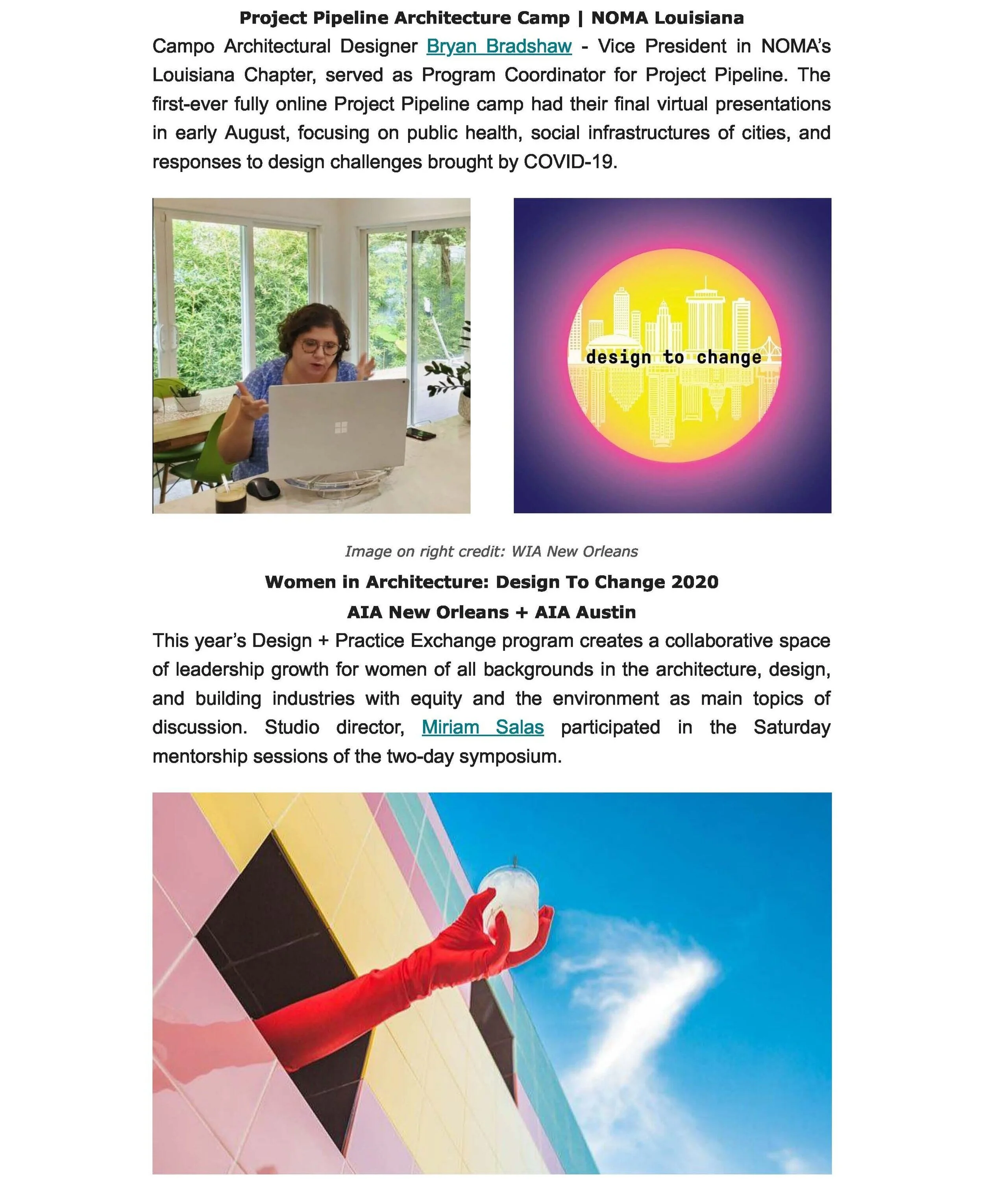
Last weekend, our Studio Director, Miriam Salas Orta, represented Campo Architects at this year's Design + Practice Exchange, a two-day symposium hosted by the American Institute of Architects and Women In Architecture chapters in both New Orleans, LA and Austin, TX.

This year’s event focused on equity and the environment. The annual DPE program creates a collaborative space of leadership growth for women of all backgrounds in the architecture, design, and building industries. The program of the Design To Change 2020 symposium included paired presentations by women in the field focused on educational typologies, roundtable conversations about environmentally-focused design in landscape, residential and equitable housing, virtual tours, and mentorship small groups. Studio director, Miriam Salas participated in the mentorship sessions on day two.

Image by WIA New Orleans

Image by WIA New Orleans

Design To Change Symposium  Saturday Morning Mentorship Session

Design To Change Symposium
Saturday Morning Mentorship Session

Image by WIA New Orleans

Image by WIA New Orleans

“Acknowledging that we don’t know it all is not just OK but it is to be anticipated. A lot of women designers don’t ask the questions that they need to be asking because they feel there is a lot of judgment that you don’t know as much as your counterparts. It makes you stronger and have a stronger voice. The second I was able to put that second-guessing to the side, I not only had an easier road but a much more fun road.”

- Miriam Salas, AIA, LEED AP

“You have the ability to represent your projects easier, better. The tools of visualization are right at your fingertips. It’s not just about your ideas but about how you present them

- Miriam Salas, AIA, LEED AP

IMG_9374.JPG


Campo Architects + InterMountain Form a Strategic Alliance to Redefine the Post-Pandemic Hotel


John T. Campo JR., AIA, NCARB Campo Architects | President

John T. Campo JR., AIA, NCARB Campo Architects | President

Mary Gilmore, AIA, NCIDQ Campo Architects | Director of Interior Design

Mary Gilmore, AIA, NCIDQ Campo Architects | Director of Interior Design

Jared Walker, InterMountain Renovation Consultants | Executive Vice President

Jared Walker, InterMountain Renovation Consultants | Executive Vice President

Colby Weaver Walker, InterMountain Renovation Consultants | Design & Purchasing Manager

Colby Weaver Walker, InterMountain Renovation Consultants | Design & Purchasing Manager


download pdf

Louisiana Extends State Commercial Tax Credit Program

On Tuesday July 14, House Bill 4 (now Act No. 25) was signed by Governor John Bel Edwards to extend the State Commercial Tax Credit to December 31, 2025.

John T. Campo, Jr., President of Campo Architects proudly serves as an advisor on state historic tax credits to Lieutenant Governor Billy Nungesser. Since the inception of State of Louisiana Historic Tax Credits, Campo Architects has utilized state historic tax credits to design adaptive reuse projects in various industries throughout the state, including hospitality, healthcare, and student housing.

We are thankful for all of the support that the state historic tax credit program has received from the public, State Representatives, and State Senators to successfully get the program extended!

Campo Architects Welcomes Historian Shelby L. Shankle

1A620059-F537-4269-B51E-04FA4F208615.jpg

Campo Architects is pleased to welcome Shelby L. Shankle as the Company’s Historian. Prior to joining the Campo team, Shelby was a historic consultant that conducted extensive research for the preparation and writing of National Register nominations on behalf of Campo Architects. Shelby’s firsthand knowledge of the Historic Tax Credit process makes her well-positioned to help clients navigate the challenges specific to their state. Her dedication to upholding the standard of excellence that Campo Architects has sustained for 35 years makes her a valuable asset to clients looking to benefit from the historic tax credits available to them through the firm's commitment to the Secretary of the Interior’s Standards of Rehabilitation. 
 

“I’m excited to join the Campo team and be a part of a firm that embraces strategic mentorship between the shared expertise of architecture, interior design, and historic tax credit consulting,” said Shankle. “In addition to the firm’s multi-faceted approach, Campo’s long-standing relationship with the National Park Service and many State Historic Preservation Offices provides clients with an exclusive understanding of the intricacies of historic preservation and adaptive reuse projects.”


As a historian, Shelby embraces the opportunity to continue learning throughout her career. She has a strong appreciation for the way that architectural preservation can be used to communicate local, state, and national histories through restoration, rehabilitation, and adaptive reuse projects. While earning her M.A. in History at the University of New Orleans, Shelby assisted the Midlo Center for New Orleans Studies with public history projects across the Greater New Orleans Area. Two of these exhibitions included Your Story, Our Story, The Tenement Museum’s crowd-sourced exhibit on the stories of immigration across the United States, and the Humanities Action Lab’s Climates of Inequality international exhibit. Her experience interacting with local and national audiences furthered her passion for making history accessible to the public through innovative ways. 

“Shelby’s technical expertise as well as her shared commitment to historic rehabilitation makes her a valuable new member of our team. The addition of a historian to Campo Architects reflects the company’s culture in providing complete services to the client in order to exceed expectations. We’re excited to welcome her to the firm and provide her unique expertise to our clients,” said John T. Campo Jr., President of Campo Architects. 

Campo Architects Statement on Racial Injustice


Campo Architects is against discrimination of any kind.  We believe in the values of diversity and inclusion for all people regardless of their race, color, sex, language, national origin, religion, orientation or age.

The tragedy of the killings of Ahmaud Arbery, Breonna Taylor, and George Floyd is truly disheartening.

The adage "Change occurs when the pain of staying the same outweighs the pain of change" could not be more applicable than now. The design community is one of many that can make a positive impact to address this problem. In order to move forward we need to work toward improving and creating a more inclusive profession that supports and encourages networks meant to foster Black Architects/Designers.

The healing of communities is not something that can directly be affected with architecture in a built form but rather by individuals in positions of power willing to listen and effectively endorse the voices of those that are underrepresented. One of our roles as Architects and Designers can be to raise awareness about our designs that promote a more equitable social environment. In doing this, we should consider having these uncomfortable conversations with each other, in and out of the Architectural profession, about creating spaces that are more diverse and inclusive.